
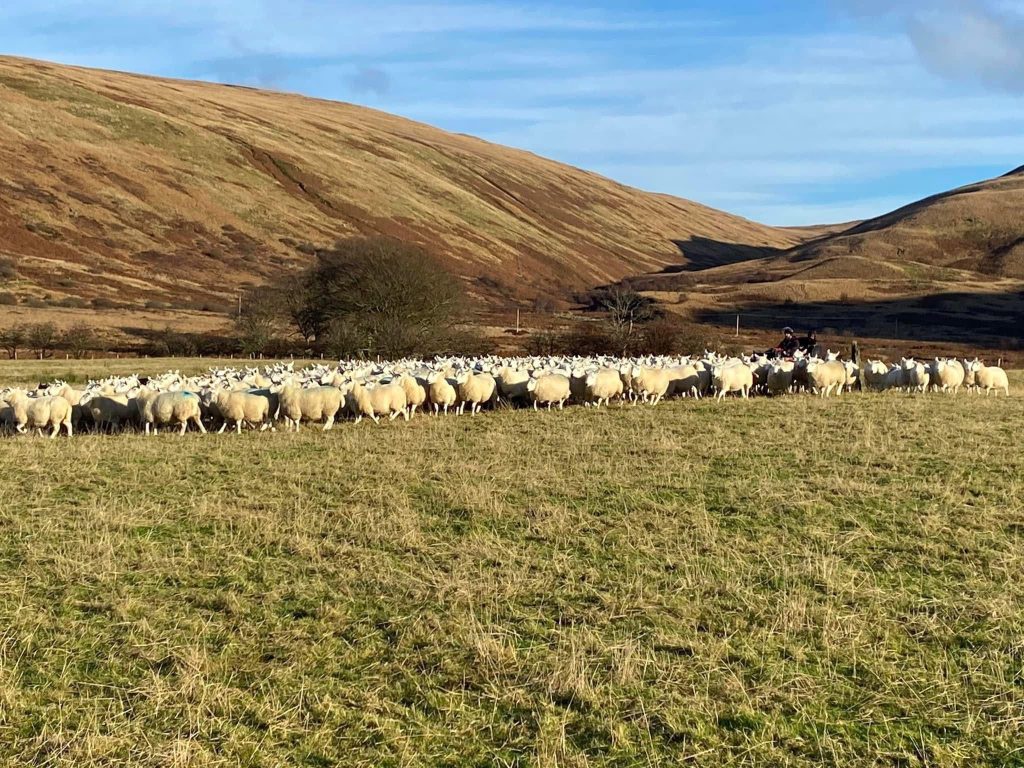
On the Isle of Arran, Callum Lindsay combines soil testing, better forage, targeted trace elements and Megastart Ewe & Lamb to support ewe condition, colostrum quality and lamb vigour across 12,500 acres of predominantly upland ground.
His approach starts with the soil and home-grown forage. He then uses blood testing and targeted supplementation around tupping and lambing, matching the product to the nutritional demands of the ewe at each stage.
Upland farming
Callum farms with his wife Zara across their home farm at Hillside, a tenancy at Monyquil and a contract farming agreement at Glenree Estate. Their system includes 3,600 breeding ewes, 47 commercial suckler cows and a 32-head pedigree Luing herd. Around 95% of the land is upland, ranging from peat, heather and scree to areas of improved green ground.
Island logistics make forward planning essential. Livestock travel by ferry to mainland markets and every farm input must be brought onto Arran.
“The boat’s king,” Callum says. “You have no control over it – if it’s not running because of bad weather, you’re not going anywhere.”
Matching ewe nutrition to forage and trace element needs
Selenium and cobalt deficiency are important considerations across the farm, especially around breeding and birth. Callum uses soil analysis, flock blood testing, boluses, drenches and feed tubs to build a programme around the needs of the ewes at each stage of the year.
“The way I see trace elements and livestock is like pH in the soil,” he says. “Unless you’re maintaining it and keeping your elements right and neutralised, you’re not going to get the optimum potential out of your livestock.”
That targeted approach matters on extensive ground, where feeding every animal conventionally is neither practical nor efficient.
For much of the year, Callum uses Crystalyx Extra High Energy to complement forage and help maintain ewe condition. As lambing approaches, he moves onto Megastart Ewe & Lamb, focusing the nutrition programme on the increased energy and protein demands of late pregnancy, as well as colostrum quality and lamb vigour.
The cattle programme follows the same principle, using Crystalyx Cattle High-Mag, Pre-Calver and Cattle Booster briefly at the relevant seasonal and production stages.
“The volume and nature of ground we’re covering means we’re not able to supplementary feed everything,” Callum explains. “We have to find a balance to make the system work – buckets form a big part of that.”
The tubs do more than provide supplementary nutrients. Callum moves them to encourage livestock into selected areas, helping manage grazing pressure and direct animals onto ground that would otherwise be difficult to use. In bracken areas, this can also encourage trampling.
“As much as we’re putting buckets out for the trace element and nutritional aspect, we’re using them as a management tool,” he says.
The golden circle
Supplementation is only one part of the system. Callum soil samples every year so lime and fertiliser can be targeted field by field. On suitable in-bye ground, direct drilling and over-seeding improve the sward without taking land out of production. As forage quality has improved, he has seen tub intake ease at lambing on those areas.
“The way I see upland farming, it’s like a golden circle,” Callum says. “Each thing feeds into the next; if you start getting one thing right, you’re going to see improvements across the board.”
The same evidence-led thinking shapes trace element timing. Annual ewe blood samples help monitor selenium and cobalt status, and the results have influenced when boluses and drenches are given. The aim is to support the ewe through late pregnancy and give lambs the strongest possible start.
Supporting colostrum quality and lamb vigour
Callum says the first Arran hill flock scan was 95%; it is now around 122%. He does not view a higher scanning percentage as the only goal, however. On the hardest hill ground, ewe capacity and lamb vigour matter more than maximising numbers.
“It’s better for ewes to raise one vigorous lamb than struggle with twins,” he says.
In a farming system that also struggles with predation from sea eagles and ravens, the stronger the lamb the better.
The result is a practical whole-farm nutrition strategy: improve the soil, get more from forage, identify deficiencies and supply targeted support as the ewe’s requirements rise before lambing.
Why Megastart Ewe & Lamb?
Megastart Ewe & Lamb is a free-access feed tub for highly productive ewes as lambing approaches. It provides energy from sugars, starch and protected fat, together with high-quality rumen-bypass protein, to help meet the demands of late pregnancy. Its balanced minerals, protein and vitamins include Vitamin E to support lamb vigour and Vitamin B1 to help reduce problems associated with cerebrocortical necrosis (CCN). It also contains high-quality mannan-oligosaccharide (MOS) to support the ewe’s immune system and colostrum quality, plus lactose as a readily available carbohydrate source.